

Good immunity isn't just about being strong. It's about balance
Ever wondered why, at certain times, you look after yourself just as usual but your body doesn't feel as ready as it used to?
Every day we face things like work stress, too little rest and changes in our surroundings, all of which can affect how the immune system works without us noticing.
When people think about immune care, they often think about making their immunity stronger. But a healthy immune system doesn't always mean one that works as hard as possible.
As well as responding to foreign invaders, the immune system also has to keep its responses and inflammation at the right level.
So caring for your immunity isn't just about stimulating it. It's about helping your body work in balance.
How can you look after your immunity every day?
Immune care starts with basics most of us know: getting enough sleep, exercising regularly, managing stress, and eating a varied diet so the body gets all the essential nutrients it needs.
Scientists are also interested in phytochemicals from food, especially quercetin, a natural flavonoid found in onions, apples and many other fruits and vegetables.
Quercetin has attracted attention for its antioxidant properties and for mechanisms related to inflammation and immune responses.
Is just 50 mg of quercetin a day really absorbed?
One interesting study is Egert and colleagues (2008), which looked at how low daily doses of quercetin affect blood levels, as well as markers of inflammation and antioxidant status.
The study involved 35 healthy volunteers, who took 50, 100 or 150 mg of quercetin a day for 2 weeks.
The chart shows plasma quercetin levels after 2 weeks of supplementation.
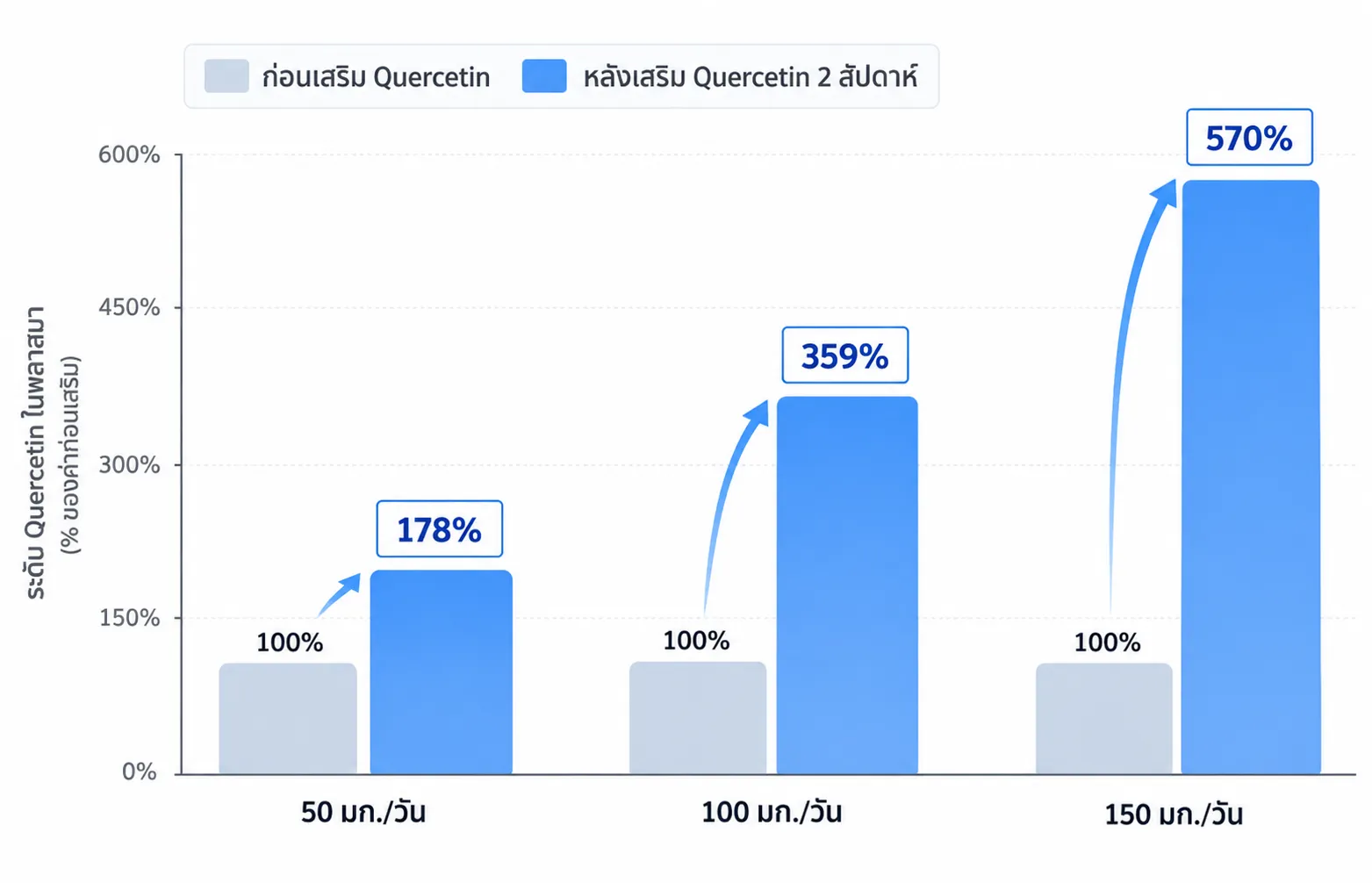
The results showed:
- 50 mg/day: an increase of 178%
- 100 mg/day: an increase of 359%
- 150 mg/day: an increase of 570%
What the study confirms is that even at just 50 mg a day, plasma quercetin levels rose clearly after 2 weeks of continuous intake.
Covering every angle of immune care with nutrients that play different roles
Quercetin is a natural compound of scientific interest, but the immune system relies on many essential nutrients to work normally.
Vitamin C — helps protect cells from free radicals
Vitamin C plays a role in the function of immune cells and helps protect cells from oxidative damage.
Zinc — a key mineral for immune cells
Zinc is needed for the development, division and function of immune cells. Not getting enough can affect how this system works.
Vitamin D3 — involved in regulating immune responses
Vitamin D is involved in both innate and adaptive immunity, and also helps maintain healthy bones and muscles.
Quercetin — a highly effective antioxidant
Quercetin is a flavonoid with notable antioxidant properties that helps support the body's immune system.
From immune care to all-round health
The immune system plays a major role in protecting the body, but good health depends on many systems working together, including the nervous system, the muscles and the processes that produce energy.
Many vitamins and minerals help enzymes and other processes inside our cells work, while amino acids are the basic building blocks of the protein the body uses to build and repair tissue.
So alongside immune care, getting enough vitamins, minerals and amino acids from a varied diet is another key foundation of looking after your health as a whole.
Good health doesn't start with caring for just one system. It starts with paying attention to every system in your body working well, every day.
- Egert, S., Wolffram, S., Bosy-Westphal, A., Boesch-Saadatmandi, C., Wagner, A. E., Frank, J., Rimbach, G., & Mueller, M. J. (2008). Daily quercetin supplementation dose-dependently increases plasma quercetin concentrations in healthy humans. The Journal of Nutrition, 138(9), 1615–1621. ↗
- Li, Y., Yao, J., Han, C., Yang, J., Chaudhry, M. T., Wang, S., Liu, H., & Yin, Y. (2016). Quercetin, inflammation and immunity. Nutrients, 8(3), 167. ↗
- National Institutes of Health, Office of Dietary Supplements. (n.d.). Dietary supplements for immune function and infectious diseases: Health professional fact sheet. ↗

We use cookies to improve performance and give you a better experience on this website. If you accept, we can show you content that better matches your interests. You can change your consent at any time via “Cookie settings”. Cookie policy